On March 30th, the opening meeting of the National Social Sciences Fund Major Project Social Impacts and Risk Governance of the New Generation of Artificial Intelligence, led by Ping Wang, Professor at our School, was held.
Huiling Feng, former Executive Vice President of Renmin University of China, National First-tier Professor, served as the leader of the evaluation panel.
Panel members also included Chuanfu Chen, University Distinguished Professor in Humanities and Social Sciences at Wuhan University;
Jianjun Sun, Professor at the School of Information Management of Nanjing University;
Lixin Xia, CPC Secretary of Central China Normal University;
Wei Lu, Vice President of Wuhan University;
Ping Ke, Professor at the Department of Information Resource Management of Nankai University;
Qing Fang, Professor at the School of Information Management of Wuhan University;
Gang Li, Professor at the School of Information Management of Wuhan University;
Guangjian Li, Professor at the Department of Information Management of Peking University;
Shujin Cao, Professor at the School of Information Management of Sun Yat-sen University;
Jianxun Zeng, Professor at the School of Information Management of Central China Normal University;
Cui Huang, Professor at the School of Public Affairs of Zhejiang University;
Xiaoguang Wang, Dean of the School of Information Management of Wuhan University.
Moreover, Falin Zhang, Associate Dean of the Academy of Humanities and Social Sciences, Wuhan University;
Jun Tao, CPC Secretary of the School of Information Management, Wuhan University,
Jiang Wu, Associate Dean of the School of Information Management, Wuhan University, attended the meeting.
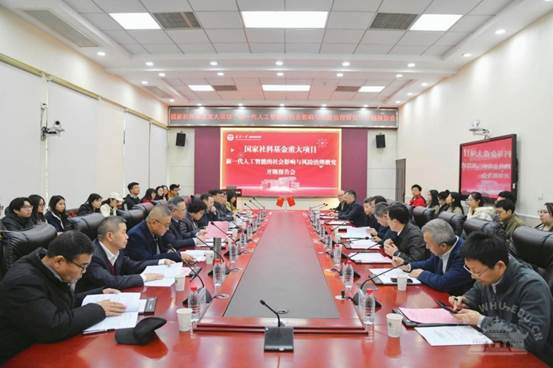
Jun Tao presided over the opening ceremony, extending sincere welcome and heartfelt thanks to the attending leaders and experts. In his speech, Wei Lu fully acknowledged the innovative exploration of the project team in the integration of liberal arts and sciences, as well as interdisciplinary collaboration between humanities and engineering, and expressed expectations for high-quality achievements of the project. Falin Zhang suggested that the project team integrate resources, focus on key points, and strive to produce results with theoretical depth and practical value, contributing to disciplinary transformation, upgrading, and the construction of new liberal arts.
Jiang Wu chaired the project kick-off report session. On behalf of the project team, Ping Wang detailed the research framework from four aspects: research background, project design, research guarantees, and research plans, as well as the collaborative research directions of the five sub-projects. Guojian Xian, Researcher at the Chinese Academy of Agricultural Sciences and representative of the sub-projects, stated that he would focus on deepening theoretical research capabilities and contribute to risk analysis and governance platform construction.
The attending experts put forward a series of constructive suggestions on strategic positioning, implementation paths, and achievement transformation. The experts emphasized that the project should adhere to the philosophy of "broad perspective, medium-scale framework, and small entry point," deeply analyzing the causal logic among AI applications, social impacts, and risk governance. While highlighting the "IM+" feature (Information Management plus), it is crucial to attach great importance to localized risk governance in culture, ideology, and other areas, focus on key fields such as education, healthcare, and government affairs, strive to produce landmark and breakthrough theoretical achievements, and actively seek to form think tank results such as policy consultation reports to contribute Chinese wisdom to global risk governance in intelligent societies.
Ping Wang expressed gratitude for the experts' suggestions, stating that they would be systematically incorporated into the project research. In his concluding remarks, Xiaoguang Wang noted that the project breaks through traditional boundaries of library, information, and archive sciences through "historical-future" dual extension, and should base itself on the foundation of information resource management, strengthen practical effectiveness, and make long-term arrangements. Wei Lu added that the university would take this project as an opportunity to further promote interdisciplinary resource integration, support innovative development in humanities and social sciences, and serve major national strategic needs with innovative theoretical and practical achievements.
 Email :